What is a mom?

According to Merriam-Webster,
the definition of "mom" is:
informal: a female parent; mother
So how can Bruno Bucciarati, a 20-year-old mafioso from the anime JoJo's Bizarre Adventure: Golden Wind, be a mom?
Hold on. How can a 20-year-old man be a mom?
It's true that Bucciarati is neither female nor a parent in the traditional sense (20 is really young to have kids!), but what if I told you that the definition of "mom" has changed in a way that now includes Bucciarati?
Among young speakers of English, the word "mom" has taken on a new, ungendered meaning, as it is now applied to anyone who is kind, caring, protective of others, and naturally takes on the role of a caregiver. Moms under this definition can be of any gender, age, or relation to those they take care of, who, in turn, are often called their "kids" when they are younger than the "mom".
Famiglia?
Bucciarati is an Italian mafioso, so naturally, he is part of a mob family, or famiglia. Specifically, he is the leader of a team of six bodyguards, himself included, whose job it is to escort the daughter of their gang's boss, Trish, to meet her father.
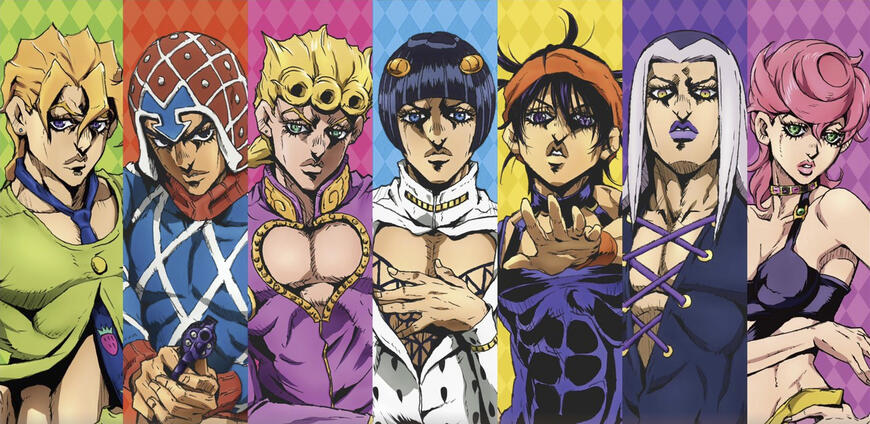
Bucciarati's team, from left to right:
Fugo (16), Mista (18), Giorno (15), Bucciarati (20), Narancia (17), Abbacchio (21), and Trish (15)
Of course, since Bucciarati is a mom, his team is more than his just his famiglia; they're seen by fans as a real family, so all of the teens on his team are considered to be his kids. That doesn't stop him from extending love and care to Abbacchio too, though! Remember, when those a mom cares for are younger than them, they are called their "kids", but moms can care for anyone! Bucciarati's brand of love can be tough at times, but that's only natural given that he and his family are gang members.
Below is a table listing Bucciarati's family members.
The characters are presented in the chronological order in which they meet Bucciarati.
Click on each character's head to view a video of the scenes described!
All videos have Japanese audio and English subtitles, and a list of content warnings.

Fugo
While eating at a restaurant, Bucciarati overhears Fugo, a homeless teenager, using legal precedent to defend his act of dining and dashing against the waiter who caught him. Impressed by his intellect, Bucciarati offers to take Fugo under his wing. Fugo refuses the offer at first, due to his explosive and violent temper that has seriously harmed others in the past. However, Bucciarati says that he will accept Fugo, anger and all, becoming the first person to ever wholly embrace every part of Fugo.

Narancia
Fugo finds Narancia, an injured teen, eating garbage on the street. He brings him to Bucciarati, who buys him a meal and pays to treat Narancia's infected eye. Narancia is eager to join Bucciarati, who tells him to go home to his father. Narancia ends up joining the mafia anyway, but it still stands that Bucciarati attempted to deter Narancia from violent gang life, for Narancia's own safety.

Mista
Mista is a teenager in jail for homicide, despite his claims that he only killed in self-defense. His story is thoroughly unbelievable to the courts, but Bucciarati, having heard about Mista, bails him out, believing in Mista when no one else does. As Mista has nowhere else to go, and now has a criminal record against him, Bucciarati offers him a new home as a member of his team.

Abbacchio
Abbacchio is a disgraced ex-cop who has become a homeless drunkard, unable to cope with the guilt of having caused the death of his partner due to having been a corrupt officer. When Bucciarati encounters him, he shows Abbacchio kindness and offers him a chance at a new life by joining his group. Abbacchio views this as an act of salvation, and greatly admires Bucciarati from then on.

Giorno
Giorno is a teenager who dreams of reforming the mafia by taking it over and ending its involvement in the drug trade. Bucciarati is initially hesitant to invite a future traitor into the gang, but he is moved by Giorno’s resolve and becomes his sole confidant in what is essentially a suicide mission, eventually becoming an ally. Despite having met in a battle that ended only moments before, Bucciarati trusts Giorno enough to give him a chance to make his dream a reality against what he believes to be impossible odds.

Trish
Trish is the girl who Bucciarati's team must must bring to meet her father, the team's boss. When they reach the designated rendezvous point, Bucciarati volunteers to be Trish's sole escort into the building. When Trish becomes nervous about meeting her father for the first time, Bucciarati verbally encourages her, and holds her hand. When it turns out that the boss wanted to meet Trish so he could kill her, Bucciarati is enraged to the point of resolving to assassinate the boss to keep Trish safe.
Pannacotta Fugo
Content warnings: none
Narancia Ghirga
Content warnings: dead parent
Guido Mista
Content warnings: guns, shooting, death, blood, prison
Leone Abbacchio
Content warnings: guns, shooting, blood, death, alcoholism, implied drunkenness
Giorno Giovanna
Content warnings: mention of drugs, implied child drug abuse, mention of amputation
Additional notes: Bucciarati and Giorno have just finished battling each other, which is why Bucciarati is aggressive in the conversation.
This clip also features Bucciarati being more conventionally "mom-like" with his actions towards the kids playing soccer in the background.
Trish Una
Content warnings: none
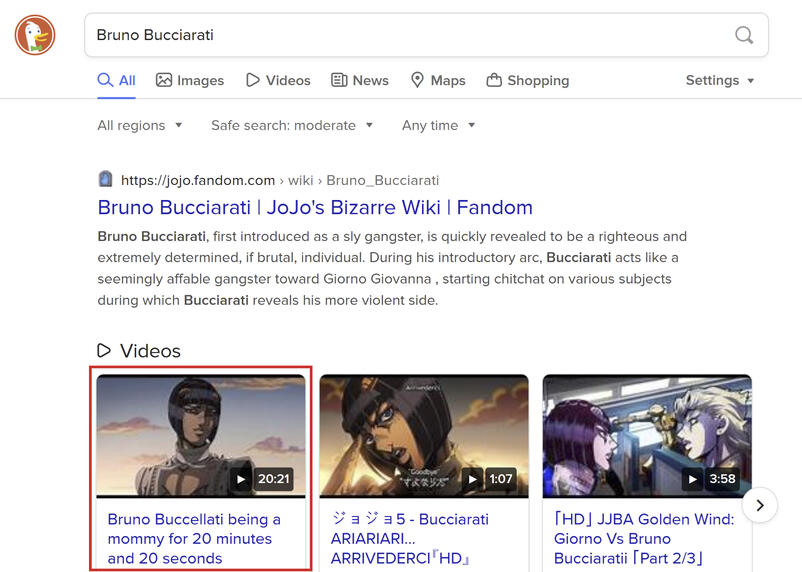
So, do fans actually call him "mom?"
They sure do! You don't have to go any further than searching his name to find an example, albeit this one is quite crass:
(Note: "Buccellati" is an alternative spelling of Bucciarati.)
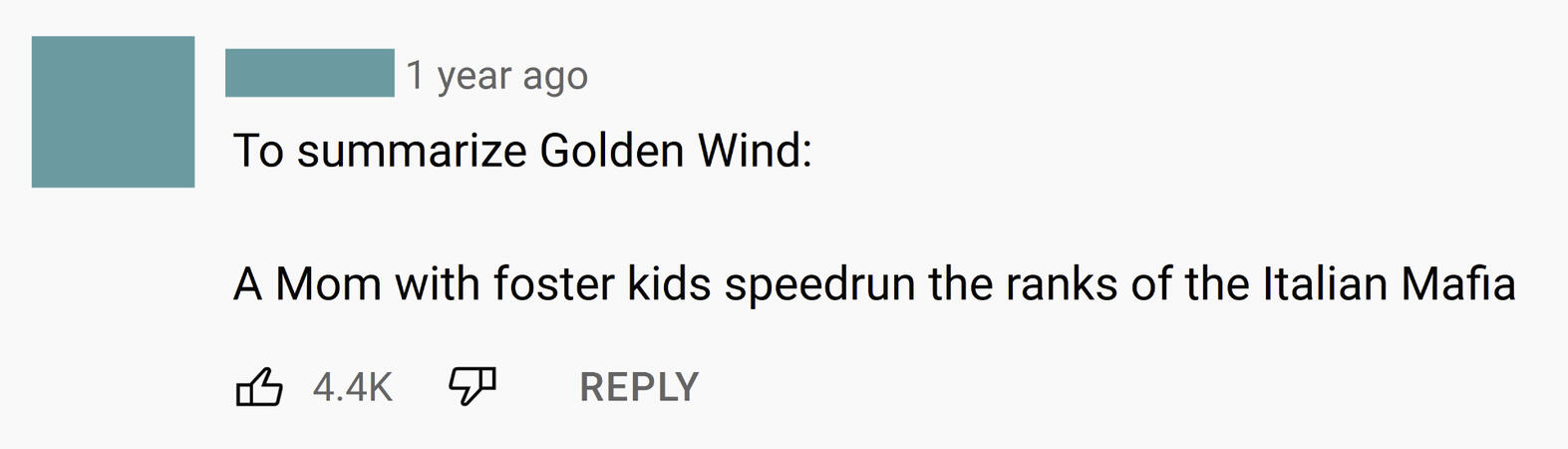
Furthermore, the comments on the video are filled with instances of fans calling Bucciarati "mom":
CW: various forms of violence, blood, and body horror in the video.



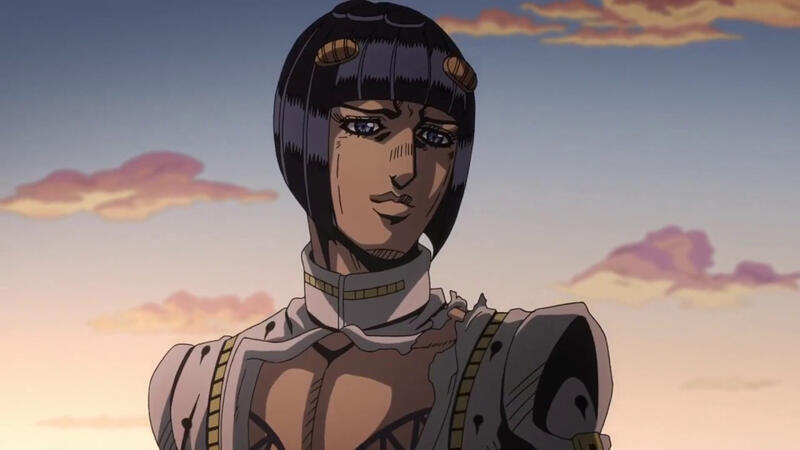
The smile in question, directed toward Narancia.
Fans calling Bucciarati "mom" is even a cross-linguistic phenomenon!
In this video, Japanese fans are reacting to Bucciarati appearing in a trailer for a then-upcoming game. At the timestamp linked, you can hear a fan scream "OKAA-SAN!", which is the Japanese equivalent of "mom".
You only need to watch about 2 seconds of the video.
Where did "zipper" come from?
"Zipper Mom" is a more specific fan nickname for Bucciarati, derived from his zipper-themed clothes and zipper-based powers. However, it's most notable as an "official" nickname of sorts, having been used at least twice by VIZ Media, the official English-language distributor of the JoJo's Bizarre Adventure series.
Here is a tweet from VIZ wishing Zipper Mom Bucciarati a happy birthday:
CW: body horror, blood, and dismemberment in linked video.
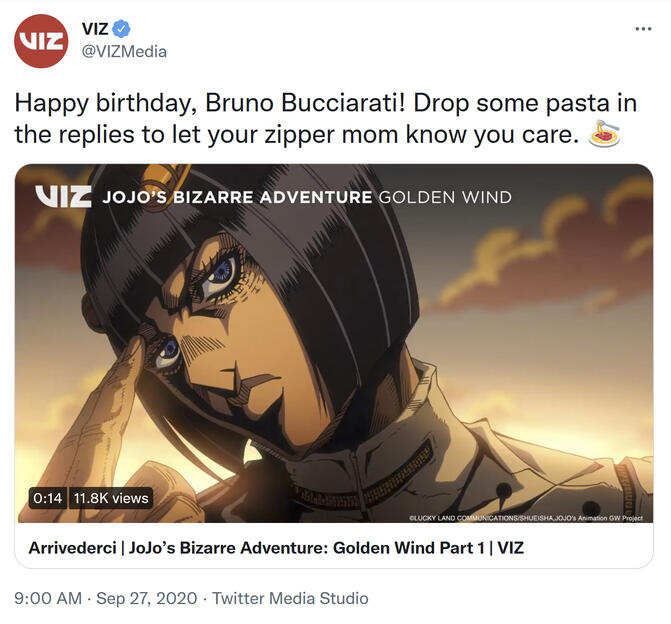
In another tweet from VIZ advertising the release of Golden Wind on Blu-ray, Bucciarati's official English voice actor, Ray Chase, even uses the nickname:

What linguistic process is happening here and why?
The changing definition of the word "mom" is due to the process of metonymy.
In this case, "mom" has lost the sense of female gender and official parenthood, but has gained the sense of specific character traits: kindness, protectiveness, and being caring. In this way, "mom" has both become more hypernymic, as it now encompasses people of all genders and relation statuses, but it has also become more hyponymic, as only people with certain traits qualify as moms under the new definition.
The reason for this shift is due to the socioeconomic role associated with mothers in heteronormative, nuclear families. In such families, the mother, or mom, is expected to do most, if not all, of the childrearing; thus, she is expected to be kind, gentle, and caring, being the sole guardian of the children during the workday when their father is away. Because of the specific expectations that come with being called a mom, the meaning has evolved to refer to anyone who displays the characteristics associated with moms. The female sense was first reduced to an implication, before being dropped altogether; although the sense of guardianship stayed, the requirement of a formal parent relationship was also reduced until it was dropped.
Arrivederci!

Our bizarre linguistic adventure has now come to a close.
Thank you for reading!
Click on Bucciarati to hear him say goodbye.
Credits:
All images were sourced from JoJo's Bizarre Encyclopedia.
All anime clips are from JoJo's Bizarre Adventure: Golden Wind.